
Async Approval Gates: Reducing Coordination Drag Without Slowing Workflows
Informal approvals create invisible bottlenecks and no audit trail. Here is how async approval gates keep work moving while maintaining clear oversight.
If approvals live in direct messages and quick thumbs-ups, you do not have an approval process. You have a hope-based system. In practice, approvals break in two predictable ways: they pile up silently, or they drift away from the work. This informal approach might feel faster in the moment, but it accumulates operational debt. Eventually, the debt comes due in the form of missed deadlines or unauthorised changes.
A calmer approach treats approvals like any operational object: they need a status, a timestamp, and a link to the work they control. By formalising this handover, you remove the ambiguity that causes delays. You shift the burden from human memory to system state. This stops work going missing when people are busy and context is split. The goal is not to add bureaucracy, but to add clarity. When the rules are clear, the team can move without chasing.
Why approvals often become invisible bottlenecks
Most teams discover their approval breakdowns only after a mistake ships or a deadline slips. The friction usually hides in two places. First, requests pile up silently. A founder marks a document as ready, but the signal gets lost in a busy channel. Second, decisions drift away from the work. A sign-off happens in one place, but the queue never updates. This disconnection between the decision and the record is where errors originate.
It is a false trade. You save time on setting up the gate, but you lose hours chasing status. The cost is not just delayed work. It is the cognitive load of remembering what is pending. When approvals are informal, ownership becomes unclear. Team members spend mental energy tracking down answers instead of doing deep work.
A more structured approach makes the invisible work visible. Without this structure, you cannot measure time to decision or identify who is blocking progress. The operational drag accumulates until it becomes a crisis. By making the bottleneck visible, you can manage it rather than suffer from it.
Synchronous versus async approval gates
Synchronous gates stop the entire process until a decision is made. The workflow halts. Nothing else moves. This is useful for high-risk changes where continuity is less important than safety. However, in most operational contexts, this creates unnecessary idle time. It forces the approver to drop everything to resolve the block.
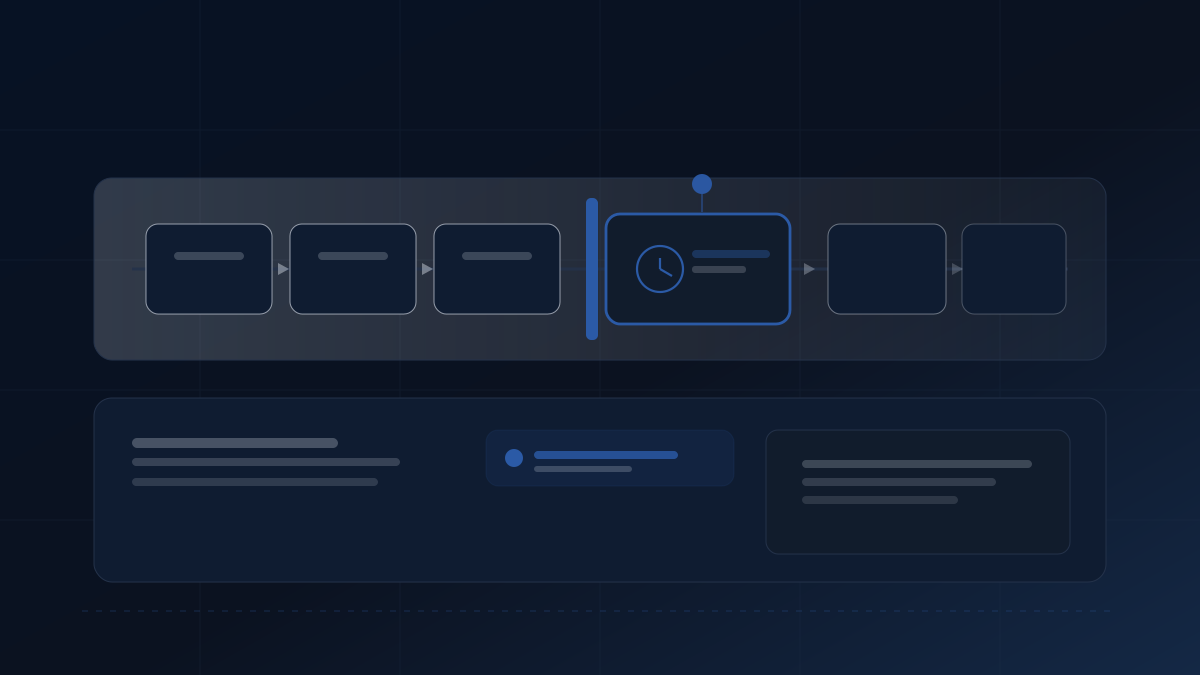
Async approval gates work differently. They allow the system to continue processing other tasks while holding the specific item in a pending state. The item is paused, but the queue remains active. Other deals can progress and emails can be sent. Only the gated item waits.
This distinction matters for throughput. In a synchronous model, one slow approver blocks the whole line. In an asynchronous model, the bottleneck is isolated. The system records the request and notifies the owner. That removes the pressure to decide instantly and protects deep work without stalling the queue. The system manages the waiting, not the human. You gain control without sacrificing all speed. This balance is essential for scaling operations without adding headcount.
Four components of a reliable async approval gate
To build this reliably, you need four specific components.
First, hold state. The system needs to know an item is pending. In tools like Notion, this means using a status property that does not change until approved. The status acts as the source of truth. Without a fixed state, the system cannot trigger the next step.
Second, direct notification. The approver must know something is waiting without constantly checking the tool. Passive visibility is not enough. The system must push the request to where the work happens.
Third, timeout and escalation. If no one answers, the system must act. Set an approval timeout (four hours is a common starting point) and escalate to a named deputy or manager. This prevents items from languishing indefinitely.
Fourth, single-action approval. The decision should take one click. If the approver has to log in, find the file, and edit a field, friction returns. Interactive buttons in chat tools can write back to the source system. Slack Block Kit allows for interactive elements that write back to the source. This keeps the loop tight and auditable. Every click writes a log entry. This allows you to calculate average time to decision later. Without the log, you are guessing.
Together, these four parts form a closed loop: request, decision, execution, evidence.
Concrete example: publishing a client blog post
Consider a client blog post ready for publication. In a broken flow, the writer messages the founder on Slack. The founder reads it later and forgets to reply. The writer asks again. Days pass.
In a governed flow, the writer updates the Notion status to “Ready for Review”. This triggers an automation. The system posts a message to a dedicated Slack channel with a link to the draft. It includes Approve and Request Changes buttons.
The founder clicks Approve. The system updates the Notion status to Published and logs the decision time. If the founder does not click within a day, the system sends a reminder. If after two days no action is taken, it notifies the operations lead. This is the escalation path.
The work does not vanish. The queue shows the item as pending. Everyone can see the age of the request. Chasing becomes a system behaviour, not a personal favour. The audit trail records who decided and when. This example shows how async approval gates protect working relationships by managing the tension. It turns a potential conflict into a standard procedure.
Managing bottlenecks: safeguards and trade-offs
This approach is not suitable for every step. Adding gates everywhere creates bureaucracy. You must distinguish between external actions and internal logs. If an action affects a client or spends money, it typically needs a gate. If it is an internal log or a draft update, it often does not.
The trade-off is speed versus control. More gates mean more safety but slower throughput. You need to find the balance that matches your risk profile. Some teams use risk scoring: low-risk items might skip the gate, while high-risk items always stop. This balances speed with governance.
You also need to manage the approval queue. If too many items sit pending, the approver becomes the bottleneck. Assign backup approvers for when the primary is unavailable. Atlassian workflows often include conditions for auto-approval based on risk scores. You can mimic this logic: low-risk items might skip the gate, while high-risk items always stop. Do not aim for zero friction. Aim for visible friction. Invisible friction is where errors hide. Visible friction allows you to measure and improve. It turns a bottleneck into a control point.
Consider failure paths. What happens if the approver leaves the company? The system must allow reassignment. What if a tool goes down? You need a manual override process. Cap retries at three, then pause and notify with the run ID, the failing step, and the next action. This ensures that technical failures do not silently block business progress.
Next steps
To sanity-check your flow, verify where the decision is recorded and what changes downstream. If you cannot answer clearly, your process is likely hope-based.
Gate actions only if they are external and carry meaningful risk. Internal updates should flow freely. Once you can see the oldest pending item and the average time to decision, approvals stop being emotional and become operational.
Start by mapping one critical workflow and applying these gates. Measure the time saved on chasing status. Use that data to justify expanding the system to other areas.
If lead follow-up needs clearer approval and ownership, start a fit enquiry and describe the current process.